

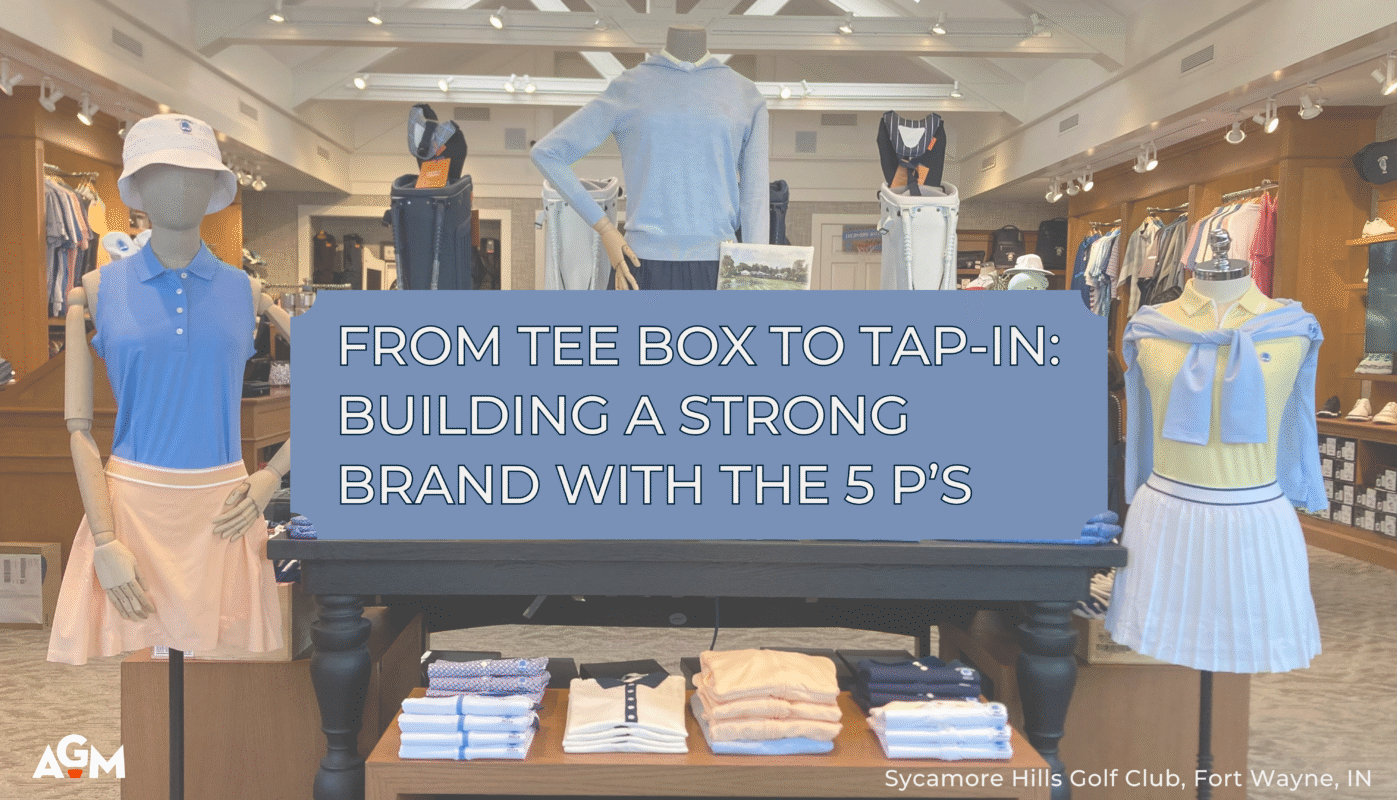
A strong brand is like a dependable golf swing. It starts with a clear setup, follows a consistent rhythm, and finishes with confidence. For retailers, that rhythm often maps to the 5 P’s: Promise, Product, Process, People, and Profit. Retail coach Pete Moore adds a valuable sixth, Promotion, because a great brand deserves to be seen.
Throughout this article, you’ll find insights from Pete that were shared during an AGM webinar, available exclusively to all AGM members.
Think of the 5 P’s as a framework to help you simplify, align, and strengthen your brand. It’s not a rigid checklist, but a guide to keep your shop focused on what matters most.
1) Promise: Your Bedrock and Tee Shot
What it is: Your Promise is an outward-facing commitment that tells customers exactly how you improve their life. It’s not your internal mission statement or vision; it’s the simple, clear message that expresses why your business exists and how it helps others.
How to approach it:
- Developing your Promise:
- Start with the customer’s problem (ex. they can’t find stylish golf apparel that’s also comfortable on the course)
- Describe how you uniquely help (ex. your shop curates performance fabrics with modern fits that move with their swing)
- End with their “better life” (ex. they feel confident and ready to play their best every round).
- Revisit your displays and marketing materials. Do they help customers imagine that better version of themselves?
When everyone on the team understands the Promise, decisions become easier and experiences become more consistent.
2) Product: Curate Like a Pro Caddie
What it is: Your assortment, services, and offerings that bring your Promise to life.
Pete’s 10-80-10 mix:
- 10% Delete: Move on from products that no longer fit your Promise or serve your customers well. “We have always carried it” isn’t a reason to keep holding onto it.
- 80% Improve: Strengthen your core assortment. Make sure bestsellers are easy to find, fully stocked, and well displayed.
- 10% Advance: Introduce newness thoughtfully. Not every idea will be a hole-in-one, but testing small keeps things fresh.
Supplier scorecard: Pete encourages using a supplier scorecard to evaluate partnerships. Score alignment with your Promise, product quality, rep support, profit margin, and reliability. This opens healthy, constructive conversations that build trust over time.
Your products should reflect who you are as a brand and what your customers value, not just what’s trending.
3) Process: From “In My Head” to “On Paper and In Use”
What it is: The systems and routines that keep your shop running smoothly, especially when you’re not there.
Pete’s rule of three: Optimize → Automate → Outsource.
- Optimize first: Document the best version of how things should work before trying to automate.
- Automate where possible: Let technology take care of the repetitive tasks so your team can focus on service.
- Outsource when needed: For seasonal surges or complex work, bring in help so your team doesn’t burn out.
Training tip: People learn differently. Combine short videos, visuals, and hands-on practice so everyone feels confident.
And remember Pete’s favorite coaching question: “What would you do if I wasn’t here?” It’s a small phrase that builds autonomy and helps your staff learn to make good decisions on their own.
4) People: Clients, Teammates, and Suppliers
What it is: The relationships that make your business feel human — and make your brand memorable.
- Identify your ideal client, ideal teammate, and ideal supplier. Just as importantly, identify those who aren’t a great fit.
- Design your experiences, hiring, and partnerships around the people who share your values.
- Hold people accountable with clarity and respect. Titles matter less than ownership of outcomes.
When people feel supported and trusted, they bring that energy to your customers. How leaders communicate, how mistakes are handled, and how wins are celebrated significantly impact the culture of the group.
5) Profit: The Score That Pays for Upgrades
What it is: Profit is what allows you to grow, upgrade, and invest in your people. It’s not just about money, it’s about freedom, sustainability, and opportunity.
Pete often asks owners: “Once profit improves, what do you want back first — time, relationships, health, or purpose?”
It’s a reminder that profitability isn’t the finish line; it’s what enables you to make better choices for your team and yourself.
Regardless of your role, think like an owner. Small, thoughtful decisions — managing shrink, adjusting displays, improving staff training — all contribute to a healthier bottom line.
6) Promotion: Tell the Story and Finish the Hole
What it is: Sharing your Promise consistently across every touchpoint so customers truly experience what makes your brand different.
Where to start:
- Story-led campaigns: Use storytelling to highlight real people and real results (member spotlights, staff favorites, before-and-after success stories, etc.).
- Omnichannel rhythm: Make sure your digital and in-store experiences feel connected.
- Document short-term goals: Create a simple 12-week “tee sheet” for planning marketing themes, channels, and goals. Check progress weekly, and adjust as needed.
Promotion isn’t about noise or fluff. Tell your story in a way that feels true to who you are, and your audience will recognize it.
Final Thoughts
Building a strong brand takes steady, intentional movement. Refining your Promise, strengthening your Product, improving your Process, empowering your People, protecting your Profit, and consistently Promoting your story. Each step, however small, brings you closer to a brand that feels aligned, confident, and ready to win every round.
This article was based on the AGM webinar, “The 5 P’s of a Thriving Business” featuring Pete Moore. To watch the full webinar and gain more industry insight, visit the AGM’s YouTube Channel. Only members can view.
To join a merchandiser community and gain weekly educational opportunities and resources, sign up to become a member of the AGM.
What Two Fashion Shows Told Us About Your Next Apparel Order
See what two fashion shows revealed about Spring/Summer 2027 trends and how they can shape [...]
Sep
Football Season in the Golf Shop: Displays, Promotions and Member Engagement Ideas
Bring football season into the golf shop with spirited displays, friendly rivalries, game-day promotions and [...]
Sep

Grandparents Day in the Golf Shop: Easy Ways to Celebrate
From gift displays and personalization to promotions, cards, and treats, discover how your golf shop [...]
Sep
Year-End Returns: An Inventory Tool, Not an Exit Strategy
Are freight, restocking fees, paperwork, and time really worth the return? Rethink inventory and discover [...]
Aug
What They Really Sell at St Andrews, the Home of Golf
From tartan to the Swilcan Bridge, discover how St Andrews turns the history and emotion [...]
Aug
Beyond the Polo: How Yardage Company Is Bringing Custom Graphics to Golf Shops
Discover how Yardage Company brings golf course stories to life through custom graphics, T-shirts, hoodies, [...]
Aug
Members Notice What You Cannot Easily See: Mid-season Walkthrough of Your Pro Shop
Have you gone shop-blind? Take a mid-season walkthrough and discover the small details your members [...]
Aug
The Questions Great Merchandisers Should Ask
Discover the questions great merchandisers ask to make smarter buying decisions and boost their golf [...]
Aug