

Retail pricing has always been part art and part science, but this year brings a new wrinkle. With the United States officially halting the production of pennies, many retailers are wondering what this change will mean for common price endings like $19.99 or $49.99. Will shoppers expect rounded prices? Will the psychology behind charm pricing still hold? And most importantly, how can golf shops continue to price profitably in a shifting landscape?
While it will take time for the retail industry and consumers to fully adapt, one thing remains true. The foundational principles of profitable pricing have not changed. In fact, this transition gives merchandisers a prime opportunity to rethink and refine their pricing strategy.
Below are the three timeless rules of profitable retail pricing, updated for today’s environment and informed by early research on shopper expectations around cash rounding.
Rule #1: Price on value, not only cost
Most independent retailers cannot make a living selling strictly at a 50 percent margin. To thrive, you must price based on value, not simply a formula tied to margin targets.
Value-based pricing starts with one question. What is the customer willing to pay? If the perceived value is higher than your current price, you have a “value gap.” This is your opportunity to raise prices without harming the buying decision.
In golf retail, many products fall into this value-driven category. Performance apparel, technology accessories, headwear, and novelty gifting often command a higher perceived value because of emotional connection or functional benefit.
Of course, you must remain competitive on items with high price transparency such as golf balls or certain equipment categories. But for most of the shop, your primary pricing anchor should be perceived value.
As consumer expectations shift around rounded pricing, focusing on value becomes even more critical. Without the crutch of .99 endings, the true worth of your product becomes more central to the shopper’s decision.
Rule #2: The psychology behind .99 pricing still works
Even if pennies are not minted anymore
Charm pricing has existed for more than a century for one simple reason: it works. Research consistently shows that shoppers process prices from left to right, placing the most emphasis on the first number they see. A price beginning with 19 feels noticeably lower than one beginning with 20, even when the difference is only cents.
With pennies no longer being produced, many retailers have asked what will happen to psychological endings like .99. The answer depends on how the U.S. phases in its rounding standards.
Most economists anticipate the following.
- Digital transactions will remain unchanged.
Consumers already pay with cards, apps, or tap-to-pay more than 80 percent of the time. Digital systems can process .99 endings without issue, meaning charm pricing will likely continue online and at the point-of-sale. - Cash transactions may round to the nearest nickel.
If rounding becomes standard, a price like $19.99 would either round down to $19.95 or up to $20.00 depending on federal guidelines. Early consumer sentiment polls show that most shoppers expect rounding to the nearest five cents and do not anticipate this will affect their willingness to buy. - Shoppers still respond to prices that “feel lower.”
Even with rounding, behavioral economists believe that prices ending in 9 will continue to communicate value because the visual anchor remains the same. This means $19.99 and $19.95 will behave very similarly in the brain.
What does this mean for your shop?
You can still use charm pricing, especially on digital and card-based transactions. And if you decide to transition to .95 instead of .99, you can still capture the psychological benefit without relying on the penny.
Rule #3: Use psychological break points
Even as you adjust endings
Certain price endings, like 2, 4, 7, and 9, reliably boost margin because they sit just under key “break points.” If a customer is comfortable buying something for $8, they will likely also buy it for $9. But jump to $10 and the hesitation begins.
This same principle applies at every level.
79 still feels noticeably less than 80.
99 still feels less than 100.
This logic holds even if your cents ending shifts from .99 to .95 or even .90. The whole dollar number remains the psychological anchor.
Examples in golf retail:
- If your keystone price lands at $22, raising it to $24 or $24.95 captures more margin without harming conversion.
- If a premium pullover lands near $78 wholesale, pricing at $149 captures the psychological break under $150.
- If you previously priced at $19.99, transitioning to $19.95 maintains the same perception while aligning with a penny-less system.
By planning your assortment around these break points, you create space to round upward, strengthen margin, and maintain shopper comfort.
What Golf Retailers Should Expect from the End of Penny Minting
The shift away from pennies is not expected to cause major disruption in retail behavior. However, here are key insights based on recent consumer research.
- Shoppers anticipate minor rounding and are largely indifferent. Surveys show that most Americans expect rounding to the nearest nickel but do not feel it will change their trust in pricing.
- Perception of fairness matters. Consistency is key. If your rounding feels predictable and transparent, customers will not question it.
- Card-dominant environments feel no impact. Since golf shops already process most transactions electronically, pricing endings like .99 will function exactly as they do today.
- Charm pricing is not going away. Behavioral research strongly suggests that the left-digit effect will continue to guide shopper perception, regardless of minting policy.
Because of these factors, most retailers are expected to keep using traditional psychological pricing even as cash rounding evolves.
Final Thoughts
The end of penny production may change how cash transactions are rounded, but it does not change the foundations of profitable pricing. When you price based on value, use charm pricing strategically, and take advantage of psychological break points, you protect your margins and guide customers toward confident buying decisions.
If you’d like examples, templates, or further guidance on pricing strategies for your specific assortment, the AGM team is always here to help.
To join a merchandiser community and gain weekly educational opportunities and resources, sign up to become a member of the AGM.
The Overlooked Power of Signage in Golf Retail
Could your golf shop be losing out on sales? Discover how signage in golf retail [...]
Oct
Behind the Curtain at Antigua
Go behind the scenes on an Antigua Factory Tour as AGM members discover the craftsmanship [...]
Oct

Building a Golf Shop Culture People Want to Be Part Of
What makes a great golf shop team? Discover how everyday leadership moments build stronger teams [...]
Oct

What’s Trending in Women’s Fashion 2026 and What It Could Mean for Golf
Explore Women’s Fashion 2026 trends from MAGIC Las Vegas and see how lace, color, prints [...]
Oct
The Shrink You Don’t See: What Golf Shops Can Learn from How the Rest of Retail Thinks About Loss
Shrink is costing golf shops more than theft. See how tighter operations, better habits and [...]
Oct

Tools and Tech Ideas to Improve Your Golf Shop Sales & Engagement
How can tools and tech turn your shop into an experience? Explore practical ideas for [...]
Oct
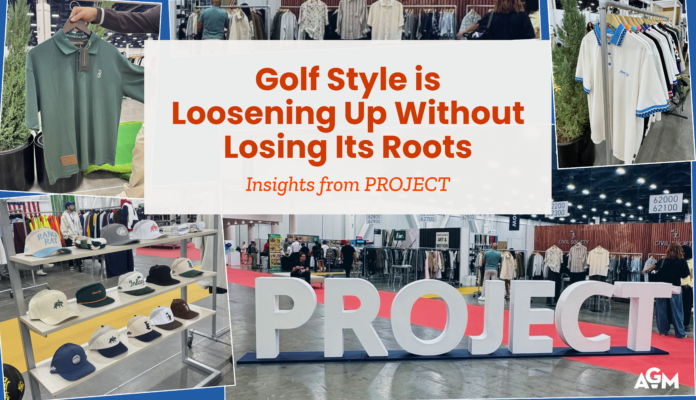
Golf Style is Loosening Up Without Losing Its Roots
Golf style is evolving with bold polos, textures and streetwear influence, helping retailers reach younger [...]
Sep

Registration Is Open for the 2027 AGM Retail Conference
It's official: registration is now open for the 2027 AGM Retail Conference! See what’s ahead [...]
Sep