

Written by Ken Morton Jr., VP of Retail and Marketing at Haggin Oaks Super Shop
In today’s golf retail environment, increasing customer traffic is important — but it is also expensive and increasingly unpredictable. Marketing costs are rising, customer acquisition is competitive, and golfers have more purchasing options than ever before. The most successful golf shops are not just focused on bringing more customers through the door. They are focused on maximizing the value of every transaction once a customer is already standing at the register.
That is where the Add-On Economy comes into play.
Average Transaction Value (ATV) is one of the most powerful and controllable profit drivers inside a golf shop. Increasing ATV by even a few dollars per sale can generate significant revenue growth without increasing staffing, inventory square footage, or marketing budgets. Top-performing golf shops understand that add-on selling is not about pressuring customers into unnecessary purchases. It is about anticipating needs, enhancing the customer experience, and making it easy for golfers to leave fully prepared to play.
Why Add-On Sales Matter More Than Ever
Many golf retailers focus heavily on big-ticket categories such as clubs, bags, and apparel. While those categories are important, they are often lower margin and less frequent purchase items. Add-on accessories — gloves, balls, headwear, towels, sunscreen, ball markers, and training aids — often carry stronger margins and create repeat purchase habits. Consider this simple example. A golf shop averaging 120 daily transactions that increases ATV by just $4 per sale generates more than $175,000 in additional annual revenue. Because add-on items frequently carry higher margins and lower inventory risk, much of that incremental revenue flows directly to the bottom line.
More importantly, customers who purchase complete golf solutions tend to report higher satisfaction and return more frequently.
Understanding the Psychology Behind Add-On Purchases
Successful add-on selling is built around convenience and relevance. Golfers often do not enter a shop planning to purchase accessories, but they are highly receptive when products are presented as part of a complete playing experience. Behavioral retail research shows that customers are significantly more likely to purchase complementary items when they are:
- Positioned physically near their primary purchase
- Presented as performance enhancers or convenience solutions
- Suggested by knowledgeable and trusted staff
- Displayed as part of bundled or themed merchandising
Add-on success is rarely about aggressive sales techniques. It is about thoughtful retail design and customer education.
Creating Natural Merchandising Adjacencies
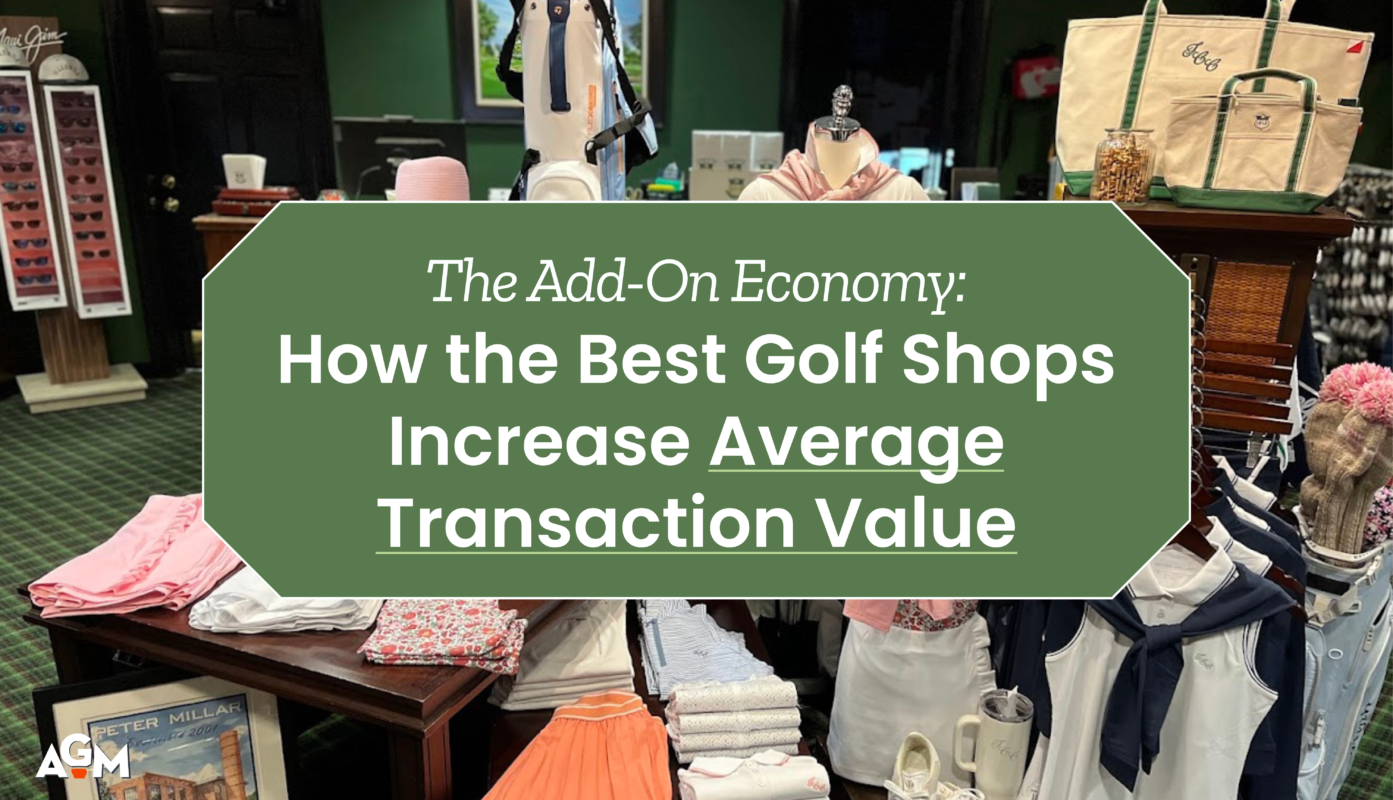
The most successful golf shops intentionally design displays that mirror how golfers prepare for a round. Rather than grouping products by vendor or category, they group products by usage. For example, glove displays placed next to golf balls create natural conversation starters about feel, grip, and performance. Rain gloves positioned near outerwear reinforce weather readiness. Rangefinder accessories placed alongside laser devices increase perceived value and protection awareness.
Forward-thinking retailers also build “Play Ready” or “First Tee Essentials” displays near checkout areas that include smaller accessory items golfers commonly forget.
These adjacencies allow the product to tell the story before staff even engage in conversation.
Training Staff to Become Equipment Advisors
Staff training remains one of the most overlooked opportunities in golf retail. Many associates are comfortable selling major equipment purchases but hesitate to recommend accessory products because they do not want to appear pushy. Top-performing shops reframe add-on selling as service rather than sales.
Instead of asking, “Would you like anything else today?” high-performing staff members use consultative language such as:
“Most players pairing that driver are also playing this ball because it helps control spin off the tee.”
“If you’re heading out in this heat, a cooling towel and sunscreen really help maintain focus through the back nine.”
These recommendations position the associate as a playing partner rather than a salesperson. Staff who personally use or test products gain authenticity and confidence in these conversations. Regular product knowledge sessions, role-playing scenarios, and daily sales coaching help reinforce these behaviors.
Bundling to Simplify Decision Making
Product bundling is another powerful ATV strategy because it removes friction from purchasing decisions. Instead of forcing customers to evaluate individual items, bundles present complete solutions. Common successful golf shop bundles include:
- New golfer starter kits
- Tournament or outing player packs
- Practice improvement kits
- Weather readiness bundles
- Travel accessory bundles
Bundles should be visually packaged and merchandised with clear messaging that communicates value and convenience. Customers often respond positively when bundles are framed as preparation tools rather than promotional discounts.
Using Data to Drive Add-On Opportunities
Modern point-of-sale and CRM platforms provide valuable insight into customer purchasing patterns. Shops that analyze basket composition can identify natural pairing opportunities and highlight missed revenue potential. For example, retailers may discover customers purchasing wedges without replacing gloves, or customers purchasing drivers who do not purchase upgraded golf balls. Identifying these gaps allows shops to adjust merchandising placement and staff training conversations.
Tracking ATV by category, staff member, and time of day can also reveal when add-on opportunities are most effective.
Leveraging Events and Fittings to Increase ATV
Fitting days, demo events, and product launch activations create exceptional opportunities for add-on selling. Customers attending these events are already engaged in equipment improvement and are highly receptive to complementary products.
Effective strategies include:
- Creating event-specific accessory displays
- Offering limited-time bundled pricing tied to fitting purchases
- Training vendor representatives to recommend accessory pairings
- Providing event checklists that highlight performance accessories
When executed correctly, event-driven add-on selling feels educational and performance-focused rather than promotional.
Gamification and Staff Engagement
Many leading golf shops introduce friendly staff competitions tied to add-on categories. Leaderboards, daily recognition programs, and team-based incentives help maintain awareness and motivation. Gamification works best when it rewards behaviors rather than just outcomes. Recognizing associates for suggesting complementary products or building complete customer solutions encourages consistent selling habits. Publicly celebrating staff success also reinforces the importance of ATV as a shared team objective.
Creating a Culture of Complete Solutions
Ultimately, successful add-on selling reflects a shop’s culture. The highest performing golf retailers do not view accessory sales as secondary transactions. They view them as essential components of helping golfers perform better and enjoy the game more. When merchandising, training, and store design align around preparing golfers for success, ATV growth becomes a natural byproduct of superior customer service.
The Opportunity Ahead
As golf retail continues to evolve, shops that master add-on selling will gain a significant competitive advantage. Increasing ATV is one of the most controllable and scalable growth strategies available to golf retailers today. It requires thoughtful merchandising, intentional staff training, and a commitment to viewing every transaction as an opportunity to deliver a complete golf experience. Retailers who embrace the Add-On Economy will not only increase revenue — they will create better prepared golfers, stronger customer relationships, and more profitable and sustainable golf shop operations.
To join a merchandiser community and gain weekly educational opportunities and resources, sign up to become a member of the AGM.
What Two Fashion Shows Told Us About Your Next Apparel Order
See what two fashion shows revealed about Spring/Summer 2027 trends and how they can shape [...]
Sep
Football Season in the Golf Shop: Displays, Promotions and Member Engagement Ideas
Bring football season into the golf shop with spirited displays, friendly rivalries, game-day promotions and [...]
Sep

Grandparents Day in the Golf Shop: Easy Ways to Celebrate
From gift displays and personalization to promotions, cards, and treats, discover how your golf shop [...]
Sep
Year-End Returns: An Inventory Tool, Not an Exit Strategy
Are freight, restocking fees, paperwork, and time really worth the return? Rethink inventory and discover [...]
Aug
What They Really Sell at St Andrews, the Home of Golf
From tartan to the Swilcan Bridge, discover how St Andrews turns the history and emotion [...]
Aug

Beyond the Polo: How Yardage Company Is Bringing Custom Graphics to Golf Shops
Discover how Yardage Company brings golf course stories to life through custom graphics, T-shirts, hoodies, [...]
Aug
Members Notice What You Cannot Easily See: Mid-season Walkthrough of Your Pro Shop
Have you gone shop-blind? Take a mid-season walkthrough and discover the small details your members [...]
Aug
The Questions Great Merchandisers Should Ask
Discover the questions great merchandisers ask to make smarter buying decisions and boost their golf [...]
Aug