

Written by Jennifer Morton, CEO Association of Golf Merchandisers
You are good at this. Better than the wider retail world gives golf credit for, and better than most boutique buyers working with the same square footage.
What you are is deep in golf. You know your vendors, your calendar, your customer, and your margins cold. Your shop is apparel-led, your hard goods are a controlled piece of the mix, and you are making apparel decisions at a level most independent retailers never reach.
So the gap is not skill. It is that golf apparel runs on its own calendar with its own vendor set, and it tends to arrive at a direction a season or two after the wider retail market has already worked it out. Golf trends and retail trends are related, but they are not the same thing, and they do not move at the same speed.
Your customer does not shop only in golf. She scrolls, she buys elsewhere, and she walks into your shop with a picture in her head that was formed largely outside our category.
That is the whole reason AGM sat in these rooms.
AGM spent August in Las Vegas across PROJECT, MAGIC, and OFF-PRICE, in the FASHION by Informa education program. Two of those sessions were spring/summer 2027 trend forecasts from the firm Future Snoops, one men’s and one women’s, each followed by working buyers who took the forecast apart and said what to do about it.
None of it was built with a golf shop in mind. That is exactly what makes it worth reading.
Start with the 10%
The most useful thing said in either room had nothing to do with color.
Samantha Connor of The Boutique Hub described building a store’s assortment like a food pyramid: roughly 70% proven sellers, 20% tested variations, and 10% for something genuinely new. That top 10%, in her words, is the candy. It will not build your business. It makes the shop taste sweet.
Ten percent is the whole answer to how a shop with a well-defined customer handles a trend that has not reached her yet. You are not being asked to touch the ninety. You are protecting a small, deliberate slice for the thing that keeps the shop ahead of its own category.
Small enough to survive being wrong. Large enough to notice when you are right.
Everything below is a candidate for that ten percent. None of it is a plan for the other ninety.
The colors are the same on both sides of the shop
This is the finding worth your time, and it only becomes visible when you look at the men’s and women’s forecasts side by side.
They did not split. The same shades kept turning up in both, which does not happen often, and it hands you something genuinely useful: one color story that works across your whole floor.
Four carried across men’s and women’s. A deep warm brown. A pale celery green, closer to honeydew than to citrus. A muted olive. A flat neutral tan.
Three more ran through the women’s side on their own. A soft mint blue. A creamy off-white. A pale wheat yellow.
Look at what is not there. No brights, no jewel tones, nothing you have to talk a member into.
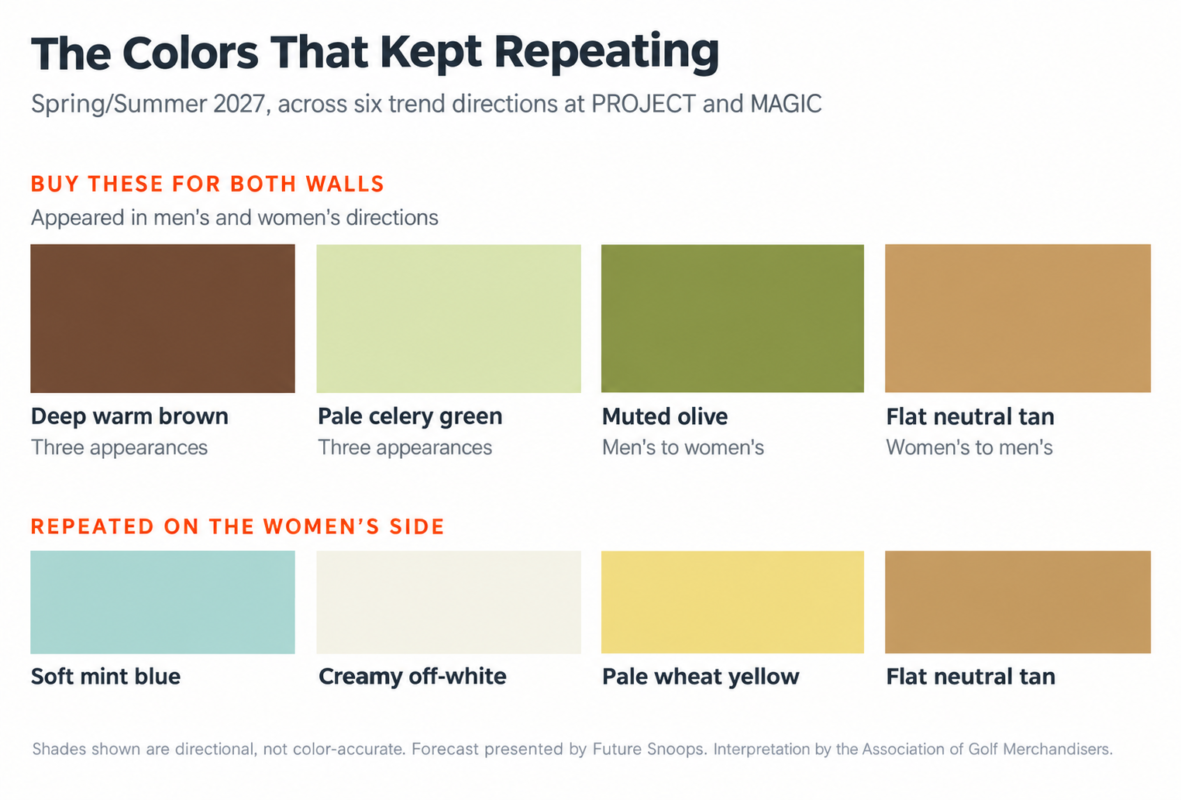
When a color survives across two genders and multiple directions, it stops being a bet and becomes a base. Pick two, buy them for both walls, and merchandise the men’s and women’s sides as one connected story instead of two departments that do not speak. A shop that does this reads as intentional from the door, which is most of what current actually means to a customer.
Same logic on pattern. Paisley showed up in both the men’s and women’s forecasts, from two different presenters at two different shows. On the men’s side, a panelist called it one of the strongest patterns running through all of 2027 and named it his single buying priority. Stripes and gingham both repeated on the women’s side. None of those need explaining to a golf customer, and all of them sit comfortably on a polo.
The three directions, translated
The wellness direction. Relaxed silhouette, soft hand, function that does not announce itself, desaturated color with brown and beige anchors. The fabric story is the real news: linen, cotton, and bamboo came up constantly, with technical fabric used where the garment needs it rather than everywhere by default.
Whether this is already your shop depends entirely on your shop. Some of you have been buying natural fiber for three seasons and will read this as confirmation. Others are close to fully performance poly and will read it as a gap. Go look at your own wall before you decide which one you are.
What the forecast is not saying is swap. It is saying both. One presenter described a customer who has stood in a hundred degrees and humidity, worked out for himself that synthetics do not breathe, and started asking for linen and cotton by name.
The sportswear direction. Preppy and retro sport, measured rather than loud. Cardigans, polos, and sweater vests named directly, alongside golf and tennis.
Then this: two of the twelve men’s key items on the Future Snoops slides carried golf in the name. Abstract Golf Shorts. Clubhouse Harrington. That is the mainstream men’s market reaching into our category for its vocabulary, and connecting it to the game’s growth with younger men. You have watched that at your own counter. This season, the forecast agrees with you.
On the women’s side, this direction runs louder. Whimsy, candy brights, playful knits. That is exactly what a ten percent slice is for.
The resort direction. On the men’s side, vacation dressing treated as a year-round state of mind rather than a seasonal category: matching sets, linen, texture, sun-dried reds and browns, and warm greens. The women’s counterpart is the romantic one, built on sentimentality and keepsakes. Lace, eyelet, tonal jacquard florals, soft gingham, shell and pearl detail.
The romantic direction will not arrive as a lace dress, and you should not buy it that way. It arrives as trim on a collar, a scalloped edge, an eyelet placket, and the jewelry case. Set lace against structure rather than layering it on itself, which is exactly how it belongs in a golf shop.
Let accessories carry the risk
If you take one tactical thing from this, take this one.
Accessories were the panels’ answer to almost every question, on both sides. Highest margin, fastest conversion, lowest unit cost.
The men’s forecast pointed at a utility neck strap, which is a misleading name because it is nothing like a conference badge holder. It is a leather or braided cord worn at the neck or crossbody with a small card wallet or phone case on the end. One panelist has carried his for eight months. Almost no golf shop carries one. Of everything in either session, it is the most open piece of ground.
The women’s forecast pointed at charm sets and hair clips. Charms clip to a bag pull, a headcover, a zipper, or a chain. A charm bar, a tray of charms, and a few base chains on the counter lets her build her own, and it lands squarely on what the romantic direction is about. It also solves member-guest and ladies’ day prizing, which is a problem you have every June.
The math is why this works. If the trend lands, you reorder. If it does not, you have not tied up open-to-buy in a dozen pieces of apparel in a color nobody wanted.
Which leads to the question to ask at the booth, before you write the order and not after the item sells out: what is your reorder policy, what are the minimums, and how fast can you ship? Test shallow. But test shallow knowing you can chase.
One more thing, on off-price
A great deal of off-price inventory is not rejected product. It exists because a vendor had to hit a 1,500 unit factory minimum and only sold 1,200. Those 300 pieces have to go somewhere.
That changes what your sale rack is for. Most shops fill it with their own markdowns at a margin that hurts. Buying off-price flips it: you acquire at reduced cost, price it as a deal, and take full margin. The rack stops being where buying mistakes go and becomes a category you planned.
You already know you have two customers, and one of them walks straight to the sale rack without making eye contact. That is not a customer to fix. That is a customer to stock for.
Spring/summer 2027 forecasts presented by Future Snoops: the men’s session at PROJECT, the women’s session by Hallie Spradlin, Director, at MAGIC. Buyer panel commentary from Samantha Connor of The Boutique Hub and Emily Lewis. AGM attended as an audience member. The golf retail interpretation is AGM’s own.
To join a merchandiser community and gain weekly educational opportunities and resources, sign up to become a member of the AGM.
What Two Fashion Shows Told Us About Your Next Apparel Order
See what two fashion shows revealed about Spring/Summer 2027 trends and how they can shape [...]
Sep

Football Season in the Golf Shop: Displays, Promotions and Member Engagement Ideas
Bring football season into the golf shop with spirited displays, friendly rivalries, game-day promotions and [...]
Sep

Grandparents Day in the Golf Shop: Easy Ways to Celebrate
From gift displays and personalization to promotions, cards, and treats, discover how your golf shop [...]
Sep
Year-End Returns: An Inventory Tool, Not an Exit Strategy
Are freight, restocking fees, paperwork, and time really worth the return? Rethink inventory and discover [...]
Aug
What They Really Sell at St Andrews, the Home of Golf
From tartan to the Swilcan Bridge, discover how St Andrews turns the history and emotion [...]
Aug

Beyond the Polo: How Yardage Company Is Bringing Custom Graphics to Golf Shops
Discover how Yardage Company brings golf course stories to life through custom graphics, T-shirts, hoodies, [...]
Aug
Members Notice What You Cannot Easily See: Mid-season Walkthrough of Your Pro Shop
Have you gone shop-blind? Take a mid-season walkthrough and discover the small details your members [...]
Aug
The Questions Great Merchandisers Should Ask
Discover the questions great merchandisers ask to make smarter buying decisions and boost their golf [...]
Aug